
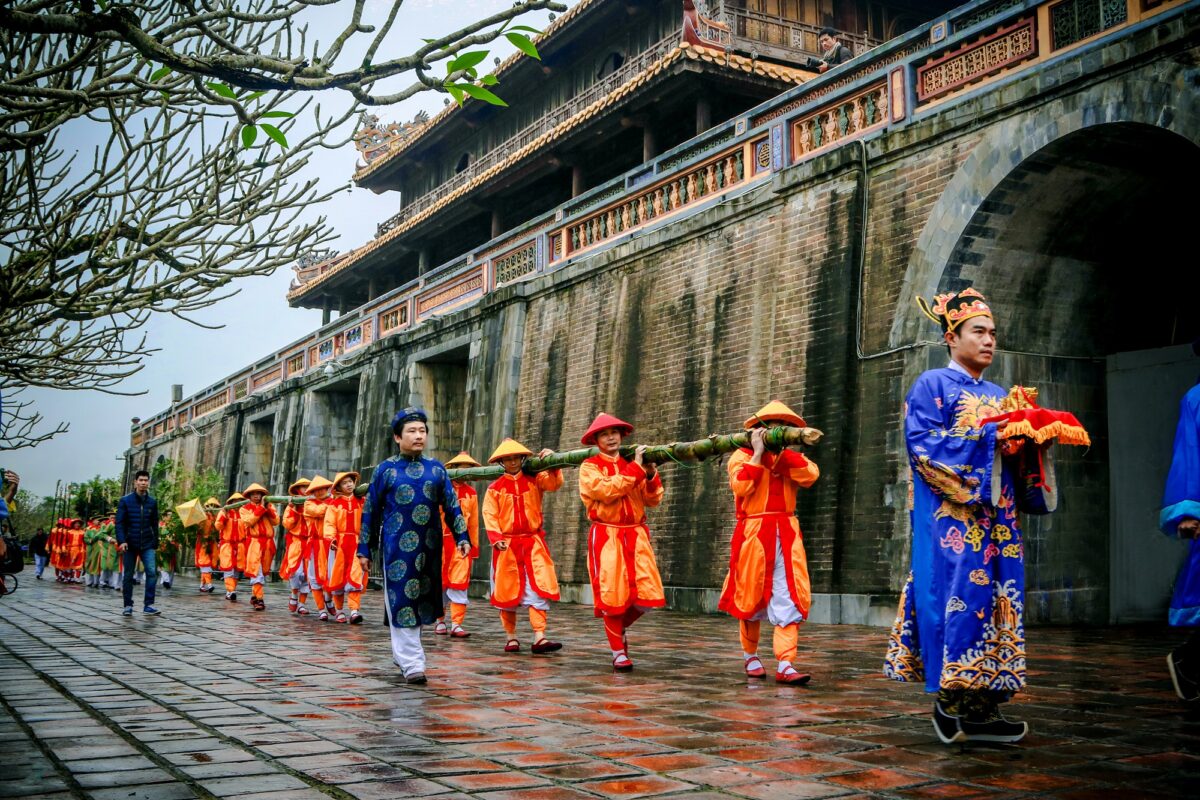
Hue Full-Day Private Car Tour – Imperial City, Royal Tombs, Garden Houses & Living Heritage Led by Women
Discover Hue through its royal architecture, elegant garden houses, traditional craft villages and everyday cultural life on a Hue Full-Day Private Car Tour Led by Women.
This private journey connects the most important heritage sites of Vietnam’s former imperial capital with the quieter neighborhoods and communities that surround them.
Rather than treating Hue as a collection of monuments, this experience follows the story of how the city developed around the Nguyen Dynasty, the Perfume River, traditional garden houses, royal cuisine and village craftsmanship.
Visit the Hue Imperial City, explore the historic atmosphere of Kim Long, discover the elegant An Hien Garden House, experience the traditional craft culture of Thanh Tien Paper Flower Village, and visit selected royal tombs including Tu Duc Tomb and Khai Dinh Tomb.
Traveling by private car allows you to move comfortably between these locations while your Vietnamese female guide provides historical and cultural context throughout the day.
With Vietnam Women Travel – Premium Private Tours Led by Women, this is more than a sightseeing trip.
It is a private cultural journey through the different layers of Hue.
Hue as a Living Heritage City
Hue is famous for its imperial monuments, but its cultural identity cannot be understood through palaces alone.
The city developed around the Perfume River, royal gardens, traditional villages, family compounds and craft communities.
Behind the monumental gates of the Imperial City are neighborhoods where generations of Hue families have preserved traditional architecture and food.
Beyond the city center are villages where artisans continue making traditional products.
The royal tombs themselves were designed as landscapes rather than simple burial structures.
This tour brings these different elements together.
Why Choose a Private Car Tour?
A private car provides a comfortable way to explore Hue’s widely dispersed heritage sites.
The Imperial City is in the urban center, while the royal tombs and traditional villages are spread across the surrounding countryside.
Instead of joining a large group, you travel privately with your own Vietnamese female guide and professional driver.
This means the day can be adapted to your interests.
Spend more time inside a royal complex.
Explore a garden house slowly.
Stop for local coffee.
Take photographs.
Learn more about Hue cuisine.
Or make a short countryside stop whenever the landscape catches your attention.
Hue Full-Day Private Car Tour Itinerary
Part 1: Hue Imperial City – The Political Heart of the Nguyen Dynasty
Begin with private car pickup from your hotel in Hue.
Start at the Hue Imperial City, the most important historical site in the former imperial capital.
Enter through Ngo Mon Gate and explore the central palace area with your female guide.
Visit key surviving structures such as Thai Hoa Palace, ceremonial courtyards and the surrounding royal architecture.
Rather than simply listing historical dates, your guide explains how the Imperial City functioned.
Learn about the emperor, royal family, mandarins, court ceremonies and the strict organization of imperial society.
You will also hear about the restoration work that has helped preserve the complex following damage during the wars.
The Imperial City establishes the historical foundation for the rest of the day.
Part 2: Kim Long & An Hien Garden House – Elegant Residential Hue
Leave the Imperial City and travel toward Kim Long, one of Hue’s historically important residential areas.
Kim Long developed as a prestigious area connected with the Nguyen Dynasty and remains known for traditional houses, gardens and quiet lanes.
Visit An Hien Garden House, one of the best-known examples of Hue’s traditional garden-house architecture.
Walk through the landscaped garden and traditional residence.
Your female guide explains how Hue garden houses were designed to combine living space, trees, plants, ponds and peaceful courtyards.
This section offers a completely different view of royal-era Hue.
The Imperial City represents official power.
The garden house represents private family life.
Part 3: Thanh Tien Paper Flower Village – Craft, River Communities & Local Tradition
Continue toward Thanh Tien Village, a traditional craft community associated with handmade paper flowers.
The village is particularly known for its colorful paper flowers used in religious and cultural ceremonies.
Visit a local artisan workshop when available and learn how the flowers are shaped by hand.
Your guide explains the cultural significance of these traditional decorations and how craft knowledge has been passed through generations.
The village is located in a peaceful rural environment, giving you an opportunity to see another side of Hue away from major monuments.
Take a short walk around the village before continuing by private car.
Part 4: Tu Duc Tomb – Royal Gardens, Lakes & Poetry
Continue to the Tomb of Tu Duc, one of the most atmospheric royal tombs around Hue.
The complex is surrounded by trees, lakes, pavilions and landscaped gardens.
Your guide introduces Emperor Tu Duc and explains the relationship between the emperor and this retreat-like environment.
Explore the lake, ceremonial structures and garden spaces.
Unlike the formal political architecture of the Imperial City, Tu Duc’s tomb feels personal and contemplative.
Your guide explains how poetry, nature and architecture were incorporated into the emperor’s vision for the site.
This is one of the most beautiful examples of the royal landscape tradition around Hue.
Part 5: Khai Dinh Tomb – A Dramatic Change in Royal Architecture
Continue to the Tomb of Khai Dinh, which offers a striking contrast to Tu Duc’s spacious gardens.
The tomb occupies a steep hillside and features elaborate stone decoration, intricate mosaics and a mixture of Vietnamese, Asian and European architectural influences.
Climb through the monumental entrance and explore the decorated interior.
Your female guide explains why Khai Dinh’s tomb looks so different from the earlier Nguyen royal complexes.
The site reflects a later period of the dynasty when international influences became increasingly visible in architecture and design.
Seeing Tu Duc and Khai Dinh on the same day provides an excellent visual comparison of two very different approaches to royal commemoration.
Part 6: Local Hue Cuisine & Riverside Neighborhoods – The City Beyond the Monuments
After the royal tombs, return toward the city for a relaxed local lunch.
Depending on the restaurant and seasonal availability, enjoy traditional Hue dishes such as:
- Bun Bo Hue
- Banh Beo
- Banh Nam
- Banh Loc
- Banh Khoai
- Nem Lui
- Fresh herbs
- Seasonal vegetables
- Local fish
- Vietnamese soup
- Tropical fruit
Your female guide explains how Hue’s food culture developed through both royal culinary traditions and everyday household cooking.
After lunch, take a final drive through selected riverside or residential neighborhoods before returning to your hotel.
If time allows, stop for Vietnamese coffee or a short walk through a quiet local area.
Hue Imperial City
The Imperial City provides the historical foundation of the journey.
Built under the Nguyen Dynasty, the complex contains royal palaces, ceremonial courtyards, defensive walls and important gates.
The architecture reflects a carefully organized imperial society.
Your female guide helps interpret the buildings within their historical context, making the visit more meaningful than simply walking from one structure to another.
Kim Long
Kim Long is one of Hue’s most atmospheric historic neighborhoods.
The area is associated with traditional garden houses and the residential culture that developed around the Nguyen royal court.
Its quieter roads and mature vegetation provide a glimpse into an older style of Hue living.
An Hien Garden House
An Hien demonstrates the elegant relationship between architecture and gardens that characterizes traditional Hue homes.
The residence is surrounded by carefully maintained greenery and a peaceful garden layout.
The experience provides insight into the private lives of established Hue families rather than focusing only on royal history.
Thanh Tien Paper Flower Village
Thanh Tien is known for its handmade paper flowers.
The craft has connections with local religious practices and traditional ceremonies.
Watching artisans create these delicate flowers provides a direct connection with the intangible heritage of rural Hue.
The village also offers an opportunity to interact respectfully with local craftspeople and understand how traditional skills survive in modern Vietnam.
Tu Duc Tomb
Tu Duc’s royal tomb is particularly notable for its lakes, gardens and pavilions.
The setting reflects the emperor’s appreciation of literature, poetry and nature.
The complex feels almost like a private retreat.
It demonstrates how royal tombs in Hue could function as carefully designed landscapes rather than purely ceremonial burial sites.
Khai Dinh Tomb
Khai Dinh represents a later and more visually dramatic period of Nguyen royal architecture.
Its steep staircase, elaborate decoration and mosaic interiors make it immediately recognizable.
European-inspired elements appear alongside traditional Vietnamese and East Asian motifs.
The contrast with Tu Duc’s natural garden setting makes these two tombs particularly worthwhile to visit together.
Hue Garden House Culture
Traditional garden houses are an important part of Hue’s architectural identity.
A garden house typically combines:
- A traditional wooden residence
- Mature trees
- Flower gardens
- Courtyards
- Ponds or water features
- Carefully planned pathways
The design creates privacy and harmony between the house and its natural surroundings.
Exploring a garden house helps travelers understand the quieter domestic culture behind Hue’s royal history.
Traditional Crafts of Hue
Hue’s cultural heritage extends beyond architecture.
Traditional craft communities continue to preserve skills connected with paper flowers, incense, embroidery, food production and other forms of local craftsmanship.
These villages provide a different perspective on heritage because the traditions remain connected to working families rather than existing only inside museums.
Hue Food Culture
Hue’s cuisine is one of the strongest expressions of the city’s cultural identity.
Some dishes were historically associated with royal kitchens, while others developed as everyday foods among local families.
The result is a cuisine known for delicate presentation, strong flavors and a wide variety of small dishes.
Your guide can introduce the history behind dishes such as Bun Bo Hue, Banh Beo, Banh Nam, Banh Loc, Banh Khoai and Nem Lui.
What Makes This Private Car Tour Different?
This itinerary is intentionally different from the other Hue tours.
It does not follow the Hai Van Pass – Lang Co – Lap An scenic route.
It does not repeat the Dong Ba Market – Thanh Toan – Phu Vang countryside itinerary.
It also avoids turning the day into a simple list of royal tombs.
Instead, it connects:
Imperial City → Kim Long → An Hien Garden House → Thanh Tien Paper Flower Village → Tu Duc Tomb → Khai Dinh Tomb → Local Hue lunch → Riverside neighborhoods.
The experience combines:
- Hue Imperial City
- Ngo Mon Gate
- Thai Hoa Palace
- Kim Long
- An Hien Garden House
- Thanh Tien Paper Flower Village
- Tu Duc Tomb
- Khai Dinh Tomb
- Traditional architecture
- Royal history
- Local crafts
- Garden culture
- Hue cuisine
- Riverside neighborhoods
- Private car travel
- Women-led guiding
Vietnam Women Travel – Premium Private Tours Led by Women
Vietnam Women Travel – Premium Private Tours Led by Women creates private experiences that combine Vietnam’s famous landmarks with authentic cultural encounters.
Our tours are private tours led by women, not women-only tours.
Your Vietnamese female guide brings together the historical and human stories of Hue.
She can explain the political importance of the Imperial City, introduce the architecture of garden houses, describe the craft traditions of Thanh Tien and help you understand the personalities behind the royal tombs.
The private format gives you greater flexibility than a standard group tour.
If you love history, spend more time inside the Imperial City.
If architecture interests you, explore the garden house in greater detail.
If you enjoy crafts, take more time with local artisans.
If food is your priority, discover more of Hue’s traditional dishes.
Comfortable Private Car Travel
Travel throughout the day in a private air-conditioned car with a Vietnamese female guide and professional driver.
This is particularly convenient because Hue’s major attractions are spread across different parts of the city and surrounding countryside.
The private car provides a comfortable base between walking visits.
The exact sequence may be adjusted according to weather, traffic, opening hours and local conditions.
Comfortable walking shoes, sunscreen, sunglasses and drinking water are recommended.
Who Is This Hue Private Car Tour For?
This experience is ideal for:
- Couples
- Families
- Private groups
- First-time Hue visitors
- History enthusiasts
- Architecture lovers
- Cultural travelers
- Photography enthusiasts
- Food travelers
- Travelers interested in traditional crafts
- Travelers who prefer comfortable transportation
- Repeat visitors seeking deeper cultural experiences
- Guests looking for private tours led by women
Book Your Hue Full-Day Private Car Tour
If you are looking for a Hue private car tour, Hue Imperial City private tour, Hue royal tombs tour, An Hien Garden House tour, Thanh Tien craft village tour, or a full-day cultural experience led by women, this itinerary offers a balanced introduction to Hue’s royal and living heritage.
Explore the Hue Imperial City, discover the elegant residential landscape of Kim Long, visit An Hien Garden House, meet traditional artisans in Thanh Tien, walk through the gardens of Tu Duc Tomb, admire the distinctive architecture of Khai Dinh Tomb, and finish with authentic Hue cuisine.
With Vietnam Women Travel – Premium Private Tours Led by Women, you experience Hue through both its monuments and its people.
From imperial palaces to family gardens, handmade paper flowers and royal tombs, this private journey reveals the many cultural layers that make Hue one of Vietnam’s most fascinating heritage destinations.